
Mechanical vs Mechatronics USA: 5 key career differences.
For aspiring engineers, the choice between **Mechanical vs Mechatronics USA** programs is a pivotal career decision. While Mechanical Engineering is one of the oldest and broadest disciplines, Mechatronics is a rapidly evolving field that bridges the gap between mechanics, electronics, and computing. In the United States, the distinction is not just academic; it dictates the industries you can enter, your eligibility for professional licensure (PE), and your potential salary. Understanding the nuances of **Mechanical vs Mechatronics USA** is essential for students who want to align their education with the demands of Industry 4.0. This guide outlines 5 critical differences to help you choose the right path in 2026.
Table of Contents
1. Core Philosophy: Broad Foundations in Mechanical vs Mechatronics USA
The primary difference in the Mechanical vs Mechatronics USA debate is the scope of the discipline.
Mechanical Engineering (The Generalist)
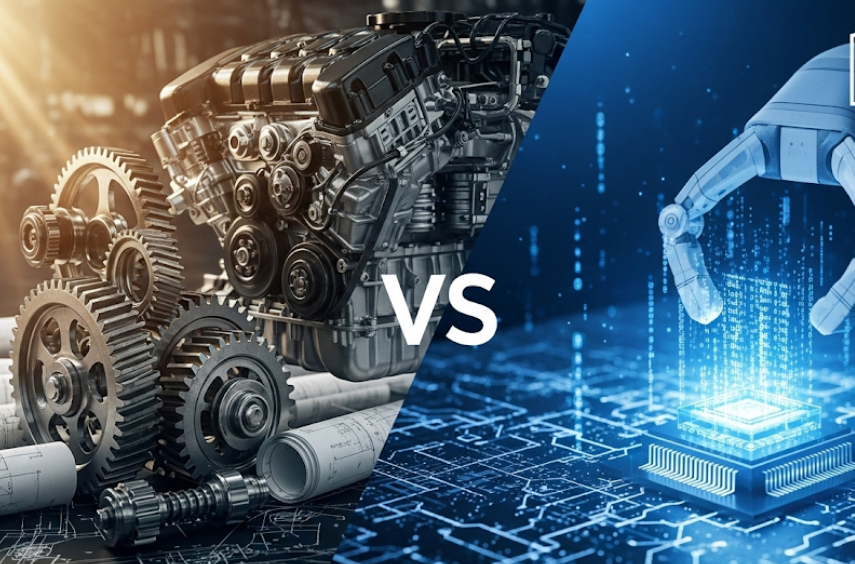
Mechanical Engineering (ME) is the study of objects and systems in motion. It focuses on pure physics, thermodynamics, and material science. A Mechanical Engineer in the USA might design a car engine, an HVAC system for a skyscraper, or the landing gear of an airplane. It is broad, foundational, and universally applicable across almost every physical industry.
Mechatronics Engineering (The Specialist)
Mechatronics is inherently interdisciplinary. It creates “smart” systems by integrating mechanical design with electrical controls and software code. A Mechatronics Engineer doesn’t just design the robot arm; they write the code that tells it how to move and design the sensors that tell it when to stop. This specialization is the key differentiator in **Mechanical vs Mechatronics USA**.
2. Curriculum Breakdown: What You Learn in Mechanical vs Mechatronics USA
US universities structure these degrees differently.
Mechanical Curriculum
Expect deep dives into:
- Fluid Dynamics and Heat Transfer.
- Solid Mechanics and Materials.
- Machine Design (Gears, linkages).
Mechatronics Curriculum
The Mechatronics syllabus sacrifices some depth in thermodynamics to include:
- Embedded Systems and Microcontrollers.
- Control Theory and Industrial Automation.
- Robotics and Computer Vision.
- Programming (C++, Python, PLC).
If you are looking for cost-effective ways to study these complex subjects, check our guide on Affordable Mechatronics Universities USA (Internal Link).
3. Industry Demand and Job Hubs for Engineers
The location of jobs varies significantly in the **Mechanical vs Mechatronics USA** landscape.
Where the Jobs Are
- **Mechanical:** Heavy concentration in the Midwest (Detroit for Automotive), Texas (Oil & Gas), and the Northeast (HVAC/Construction).
- **Mechatronics:** Concentrated in “Smart Manufacturing” hubs like Silicon Valley (Robotics), Boston (Biotech automation), and Seattle (Advanced Tech).
For students seeking practical experience, landing an internship is crucial. We have compiled a list of the best sectors in our article on Top Internships in the USA 2026 (Internal Link).
4. Licensure and Salary: The Financial Impact
Professional licensure and earning potential are practical considerations in the **Mechanical vs Mechatronics USA** decision.
The PE License Factor
In the USA, the “Professional Engineer” (PE) license is often required for senior Mechanical Engineering roles, especially in HVAC, construction, and public utilities. The PE exam structure is heavily tailored toward traditional Mechanical disciplines. Mechatronics engineers rarely need a PE license, as their work in tech and robotics typically does not require it.
Quick Comparison: ME vs. Mechatronics
| Feature | Mechanical Engineering | Mechatronics Engineering |
|---|---|---|
| Avg. Entry Salary | ~$75,000 | ~$82,000 |
| Primary Focus | Hardware & Physics | Hardware + Software |
| Top Skills | CAD, Thermodynamics |
Robotics, PLC, Control
|
official employment statistics and projections, you can consult the U.S. Bureau of Labor Statistics (BLS)
Choosing between **Mechanical vs Mechatronics USA** depends on your career goals. If you want broad flexibility and the option to work in traditional infrastructure, Mechanical Engineering is the safe bet. However, if you are passionate about automation, robotics, and the intersection of code and machine, Mechatronics offers a specialized and higher-paying path for the future.
